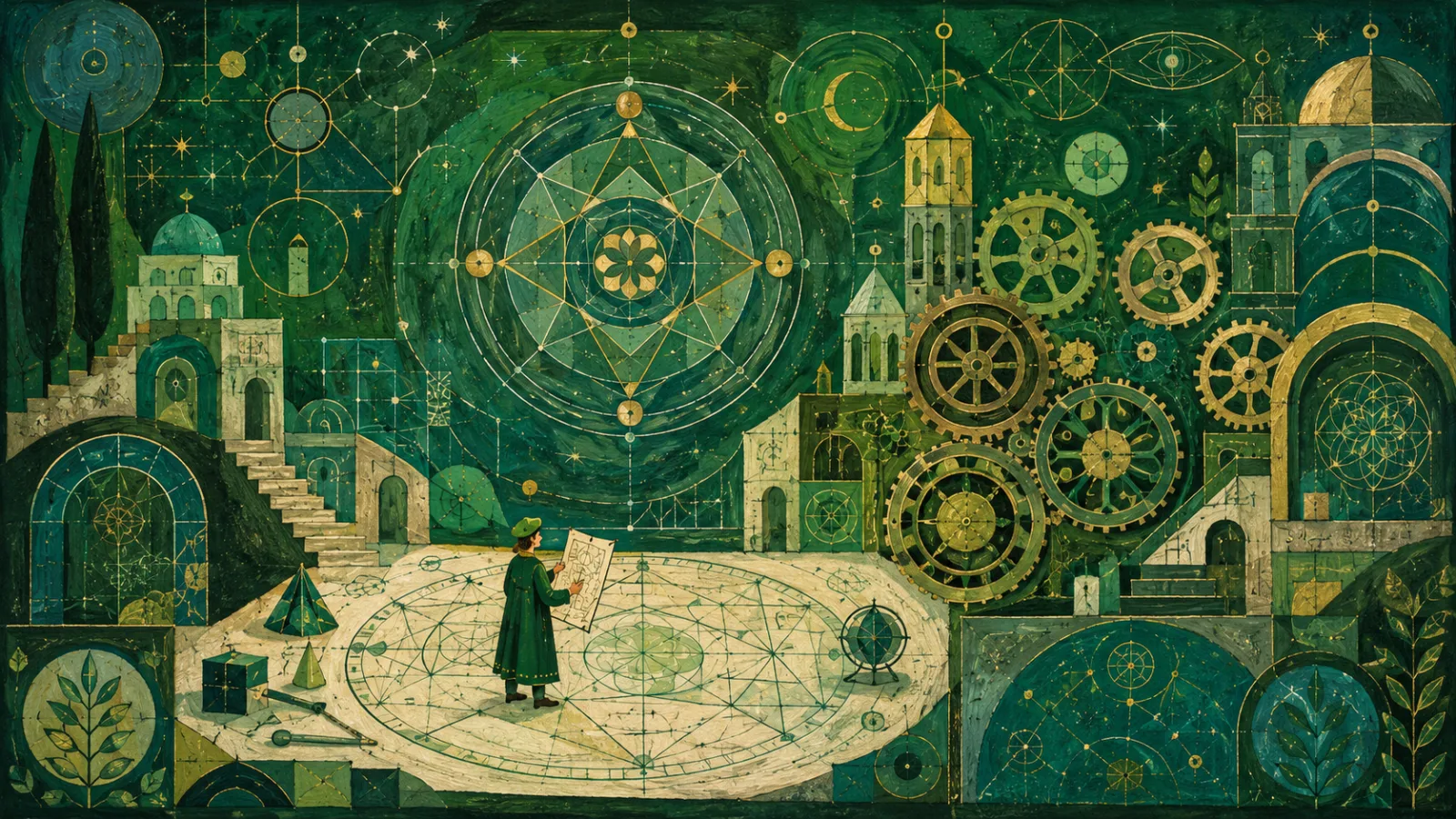
📐ARCHETYPE 13 / 24Wisdom (Security)
The Grand Architect
"The world wobbles because nobody drew the blueprint first. So I draw the schematic before anyone else moves."
The Core Essence
The Drive
To convert chaos into a system, and build a structure with your own hands that doesn't collapse no matter what variables walk in. For you, a flawless design isn't a compulsive tic — it's the most honest expression of responsibility from someone determined to keep their people and their work safe inside an unpredictable world.
The Fear
Decisions running purely on emotion with no data underneath, the kind of crack in a system that can't be patched once it breaks. The moment someone says "let's just go with the vibe," it doesn't register as a difference of opinion — it registers as a threat to the entire safety net.
Identity Keywords
- system designer
- data driven decisions
- logic first doctrine
- perfectionist shadow
- principles above all
Your Energy Map
The surface is calm, but the inside is a computation room running 24/7. When external stimulus arrives, you don't react first — you classify, asking "where does this input slot into my model?" In the moment of decision, you don't hesitate, because you've already run the simulation in your head dozens of times.
Mindset & Action
"A cold-eyed architect who filters out emotional noise and picks the most structurally sound option."
Your brain isn't a meeting room — it's a design office. When information arrives, you first separate variables from constants, then build a decision tree on top of that. You find people who run on raw intuition exhausting to watch, even though you rarely notice that your own intuition is just hundreds of accumulated data patterns firing at once.
Energy Saver Mode
Your energy-saving move is "drive the cost of mistakes to zero before execution." While other people are getting broken open in the execution phase, you've already simulated every branch at the design phase and quietly pre-empted the absurd losses. You build a manual so the same question never has to be answered twice, and you document decision rules so the same meeting never has to happen twice. That's why you look slow on the surface, but you cover the longest distance on the least amount of fuel.
The Overthinking Loop
Your most expensive debt is the time you postpone execution because "the model isn't finished yet." In situations where 70% of the information is plenty to start, you try to push it up to 95% — and meanwhile the market or someone's emotional state has already shifted. The instinct to control more variables ends up missing the biggest variable of all. That's the paradox.
Social DNA
"A curator of principles who only turns warm inside a clearly defined rule set."
You feel deeper love through trust built on explicit rules than through fuzzy intimacy. To someone who has agreed on the rules with you, you become one of the most consistent and dependable people they'll ever meet — but the moment someone tries to blur the rules, the shutter comes down instantly.
Social Minimalism
You're almost entirely uninterested in the size of your network. You'd rather go long with a verified handful, anchored on clear agreements. You instinctively pull back from people who only repeat emotional pleas and from people who turn the same mistake into a pattern. But for someone inside your trust circuit, you spare no time and no resources to engineer the best possible structure for them.
Love & Boundaries
Your love grows through accumulated, consistent promises rather than surprise gestures. When your partner breaks the same promise repeatedly, it's not that love cools — you actually rule that "this relationship's system is broken." You feel love most deeply when your partner is focusing on their own work inside your rule set, and you're quietly drawing the next blueprint right next to them.
Your Circle
The Comfort Zone
The Iron Sovereign: The best execution partner — they take the blueprint you drew and drag it onto the field without a moment's hesitation. The instant your schematic meets their drive, vision turns into reality. The Silent Decoder: An intellectual peer with the same data instinct. You build the system; they quietly point out the patterns your system missed. When the two of you are together, the information blind spot nearly disappears.
Growth Sparks
The Passionate Instigator: A wild force who just jumps in without any blueprint and lets the variables hit them directly. Every time their spontaneity shakes your model, you relearn that "some things still get to live even when they can't be predicted."
The Energy Drainers
The Ambiguous Weaver: A master of ambiguity who refuses to give a clean answer and parks inside the gray zone. In front of their fog, your system's variable count spirals without end, and you end up spending your most expensive energy fighting ambiguity itself.
Work & Life
Best-Fit Career
Positions where complex problems only deliver results once they've been structured. System design, strategy planning, data analysis, architecture, policy and institutional design — environments where one well-built frame keeps running for a long time — are where you create the most value. Improvised organizations where the rules change daily, and environments where internal politics beat data, wear your strengths down the fastest.
Your Growth Path
Your next chapter lives in the shift from "perfect design" to "design that's testable." The moment you accept a tight feedback loop — short hypothesis, short verification — instead of trying to control every variable, your system starts evolving much faster. The courage to ship a 70% model and fill in the remaining 30% from the field, plus the flexibility to admit that "emotion" is also part of the data, is what turns you into a real master architect.
Your Strategy Note
Your love of systems isn't a control freak's compulsion — it's the deep responsibility of someone who learned early that freedom only exists on top of a foundation that doesn't crumble. You instinctively know that somebody has to draw the blueprint so everyone can live in the same building. The thing is, no blueprint contains the full shape of a life. Some lives only happen outside the schematic.
Today, take one task you would normally postpone until the model was airtight, and ship it at 70%. The experience of patching the gaps on the field will make your next blueprint dramatically more solid. In the end, what makes you strongest isn't a more elaborate design — it's the flexibility to accept variables that live outside the design.
MORE IN THIS GROUP
Is this you?
Your Four Pillars point to one of the twenty-four. It takes a birth date and a minute.
Find my archetypeSee all 24